

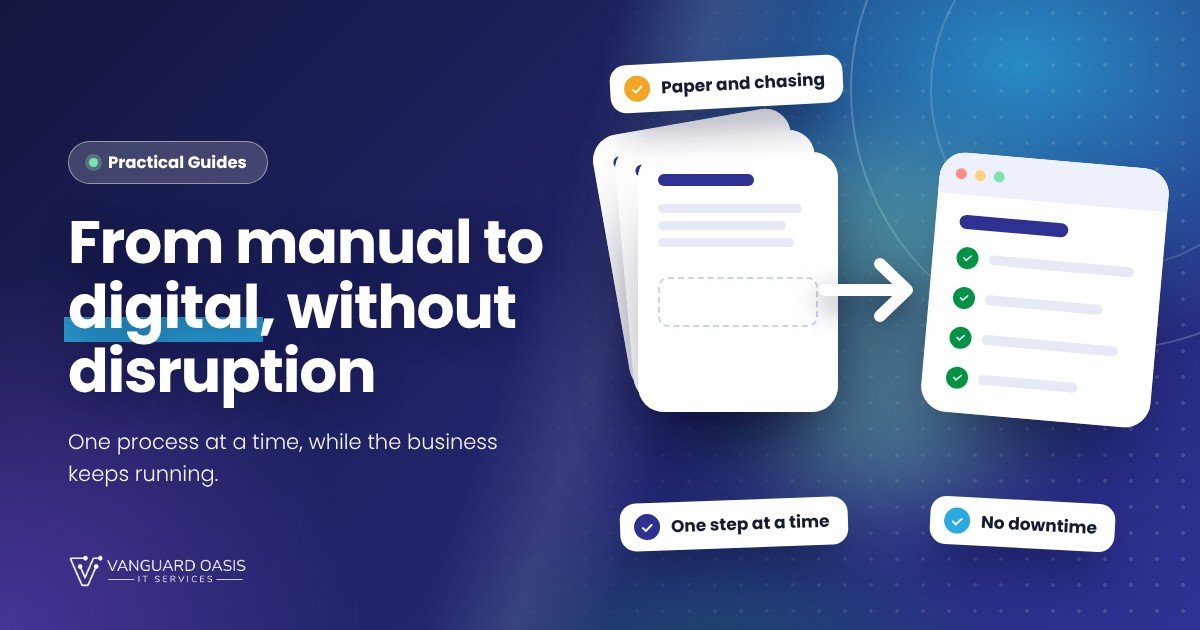
Nobody wants to stop trading for three months while the systems change. The good news is that you do not have to. The businesses that digitise well rarely do it in one go. They do it one process at a time, with the old way still available until the new one has proved itself.
Start with one process, not the whole business
Pick the process that causes the most pain and has the clearest edges, such as quotations, bookings, purchase approvals or stock counts. A good first candidate is repetitive, involves several people, and goes wrong in the same ways each time. A bad first candidate is the one everyone argues about.
Seven steps
- Map what really happens. Not what the procedure says. Sit with the people who do the work and write down each step, including the workarounds. This is the step that gets skipped, and it is the one that matters most.
- Fix the process before you automate it. A system will faithfully repeat a confused process. Remove the steps nobody needs first.
- Choose the simplest tool that does the job. That may be a form and a shared sheet, an existing app set up properly, or a small custom build. Bigger is not better.
- Run old and new in parallel for a short time. Keep the paper or spreadsheet going alongside the new system for a couple of weeks, so a problem does not stop the business.
- Move in slices. One team, one product line or one branch first. Learn from it, then roll out.
- Train people on their own job. Short sessions, using their real examples, work much better than a general demonstration.
- Measure and retire the old way. Agree what better looks like, such as time saved or errors avoided. Check it, then switch the old process off for good.
Where disruption usually comes from
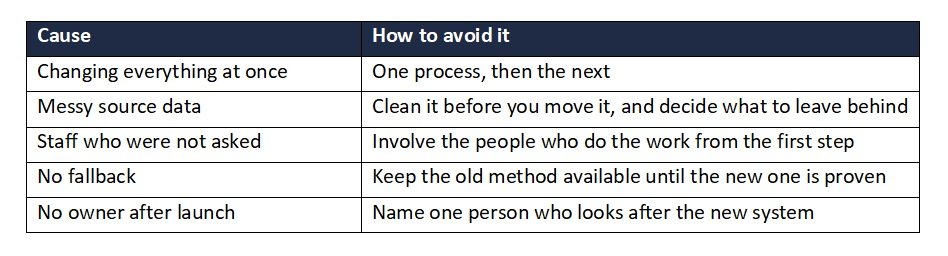
Do not forget the people
The tools are the easy part. What decides whether a change sticks is whether people trust it and find it easier than the old way. Tell your team what is changing and why, listen to what they say about the current process, and fix the annoyances they raise early. A small visible win in the first month does more for confidence than any presentation.
How we help
For wider modernisation, our Digital Transformation service begins with a paid audit of your systems and processes, then a roadmap prioritised by what will move the needle, not by what is newest. You keep the roadmap, so you can build with us, with a partner or with your own team. For a single process, such as replacing a shared spreadsheet, a scoping session is usually enough. It is a two-hour working session that ends in a one-page brief, for AED 500 to 750, credited in full if you go ahead and build with us. Prices exclude 5% VAT.
Which process should come first?
Book a free call and we will give you a rough estimate and an honest view on what fits your business. We reply within one working day.
0 Comments