

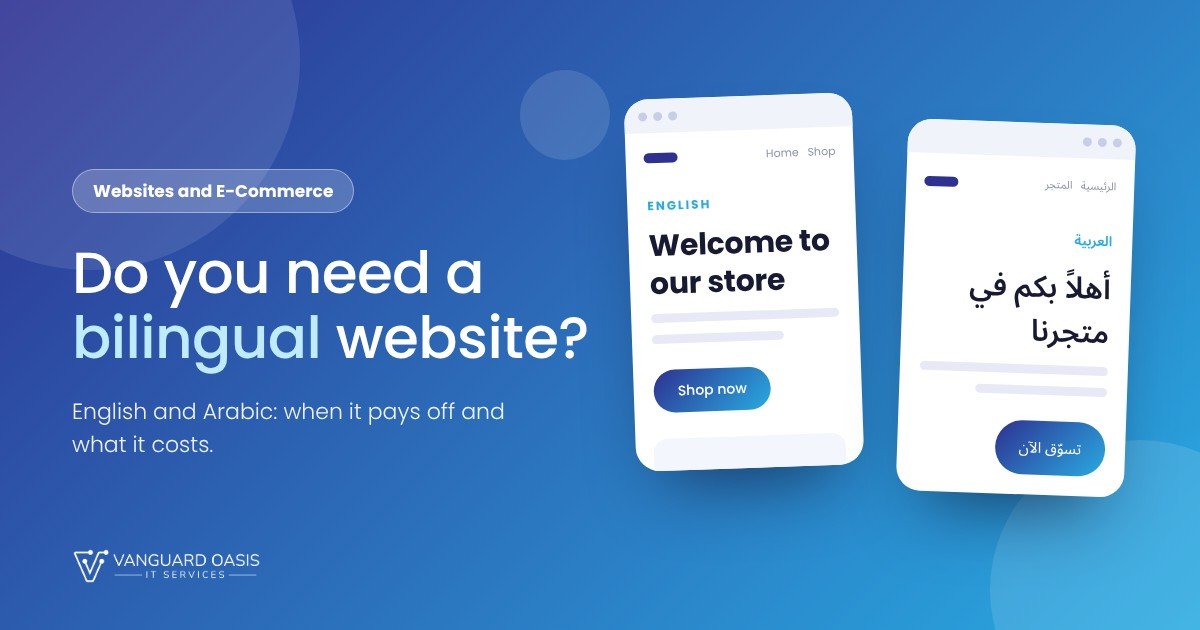
In the UAE, people expect to see Arabic. Whether your website needs it is a different question, and the answer depends almost entirely on who you are trying to reach.
When a bilingual site makes sense
An English and Arabic website is worth the extra cost when:
- You sell directly to Arabic-speaking customers, as a shop, a restaurant, a clinic or a service business would.
- Your buyers include government or semi-government bodies, or established local companies that run in Arabic.
- Your competitors all have Arabic pages, and you would look unfinished without them.
- You want to be found by people searching in Arabic.
Your licence or sector expects it. If you are not sure, ask your licensing authority or adviser.
When English alone is fine
A business-to-business company dealing with international clients, a young business testing the market, or a single-page site on a tight budget can all do well in English. A sensible plan is to launch in English, do it properly, and add Arabic when it earns its place, as long as the site is built so that adding it later is straightforward. Ask your builder that question up front.
What "bilingual" really involves
It is not just a translation dropped into the same layout. Arabic is written right to left, and that touches nearly everything.
- Mirrored layout. The menu, the text alignment, arrows, icons, forms and tables all flip. Get one wrong and it shows.
- Proper Arabic text. It should be written or checked by a native speaker. Machine translation reads as machine translation, and customers notice.
- A suitable typeface. Arabic needs its own font, chosen to sit alongside your brand.
- Separate pages for each language. There should be a language switcher and correct language settings, so search engines show the right version to the right person.
- Images with text in them. Banners and graphics need an Arabic version too.
- Everything around the pages. For a store, that includes checkout messages and order emails.
What it costs with us
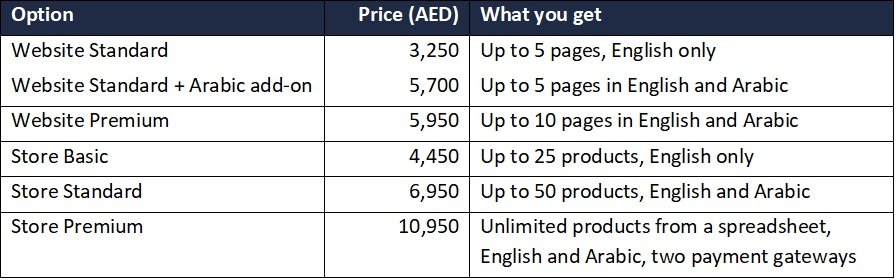
Arabic is built into our higher packages and available as an add-on for the others. The Arabic text itself is supplied by you.
Getting the Arabic right
Hire a native writer or reviewer, and give them your English text along with a short list of names, product terms and anything that must not change. Decide the tone before they start: formal for government and corporate buyers, friendlier for a consumer brand. Check numbers, dates and prices once the pages are built, because they are the easiest things to get tangled in right-to-left text. Allow room in headings and buttons too, since Arabic text rarely takes the same space as the English it replaces. Then read every page on a phone, ideally with someone who isn't on the project.
Arabic and search
Each Arabic page is its own page, so it needs its own title and description written in Arabic, not copied from the English one. Treated that way, it can be found by people who search in Arabic, which an English-only site will never be. Treated as an afterthought, it will sit there unseen.
The cost nobody mentions
Building the Arabic pages is a one-off cost. Keeping them up to date is not. Every new page, product, offer or price change has to be written twice, and the Arabic version has to be checked. If you update your site every week, that is a real commitment. Make sure someone owns it before you say yes.
Three questions to decide
- Do your customers or buyers ask for Arabic, or expect it?
- Will someone write and check the Arabic text, and keep it current?
- Would the money do more good elsewhere right now, such as better photos, a stronger English site or an online store?
Not sure whether you need Arabic?
Book a free call and we will give you a rough estimate and an honest view on what fits your business. We reply within one working day.
0 Comments