

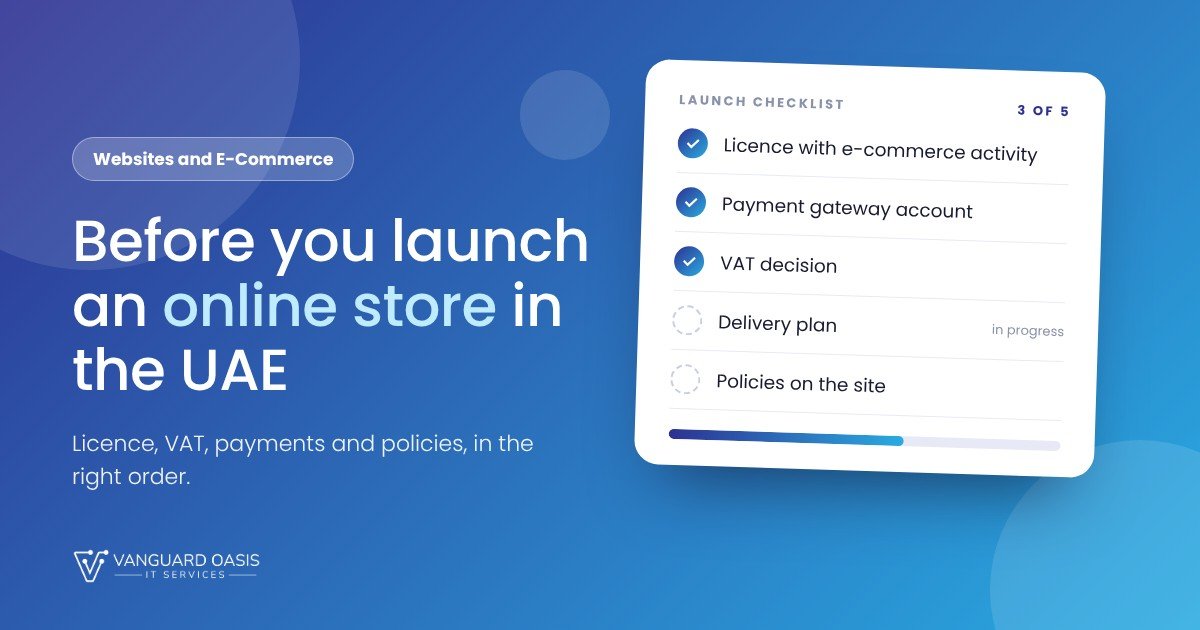
Building the store is the easy part. What holds up a launch is usually everything around it: a licence with the right activity on it, a payment gateway account that has been approved, and policies a customer can actually find. Each has its own waiting time, so start them while the store is being built, not after it is finished.
One caution first. This is general guidance, not legal advice. Rules differ by emirate, free zone and business type, so confirm the details with your licensing authority or an adviser.
1. A licence that covers selling online
On the mainland you need a commercial licence that includes e-commerce activity, issued by your emirate's economic department. Some emirates issue a separate e-commerce licence, while others add the activity to a standard commercial licence. According to the UAE government portal, every e-commerce licence also needs approval from the Telecommunications and Digital Government Regulatory Authority (TDRA).
If your company is in a free zone, your licence comes from the free zone authority. It lets you sell online within the free zone and internationally, but selling directly to customers on the mainland may need additional permits. Online trade as a whole is governed by Federal Decree-Law No. 14 of 2023 on Modern Technology-Based Trade.
Do this first. Everything else, including opening a payment gateway account, depends on it.
2. A decision about VAT
VAT registration is mandatory once your taxable supplies and imports pass AED 375,000 over the previous 12 months, or you expect them to within the next 30 days. You can register voluntarily from AED 187,500 on the same basis. Below that, you are not required to register, and a business that isn't registered generally shouldn't add VAT to its prices. Speak to your accountant before you set them.
This matters for the store because it decides how prices are shown. Our stores can display prices with 5% VAT where you want them to, but whether they should is your call, not a design choice.
3. A payment gateway account
To take card payments you need an account with a payment gateway. Providers usually ask for your trade licence, a business bank account and the owner's ID, and approval can take a few weeks. Fees vary by provider, so compare at least two before you apply.
You don't have to wait for it to open the store. Cash on delivery and bank transfer are built into WooCommerce and need no gateway, so a store can go live with those and add cards when the account comes through. If you want buy-now-pay-later, such as Tabby, that is a separate arrangement and an extra gateway on our side (AED 1,250). You register with gateways yourself. We help with the set-up.
4. A delivery plan
Decide how orders will reach customers before you build, because it affects the checkout. Many small shops start with simple flat delivery charges, or free delivery above a set amount, which you can set up yourself. Live carrier rates and booking need a shipping integration (AED 1,500 for one carrier). Whatever you choose, state the delivery time clearly and decide how you will tell customers when something runs late.
5. Policies and seller details on the site
Customers need to be able to find your returns policy, your delivery terms and your privacy policy before they buy. Show who is behind the store too: the name of the legal entity and your trade licence details, somewhere a customer can see them. Ask your licensing authority exactly what it expects to appear.
6. The content itself
Product descriptions, specifications and photos have to match what you deliver. A domain and a business email address, such as orders@yourshop.ae, round it off. If you don't have product photos, they are the slowest part of many store builds. We can edit and prepare them at AED 115 an image for the first 25.
Who handles what
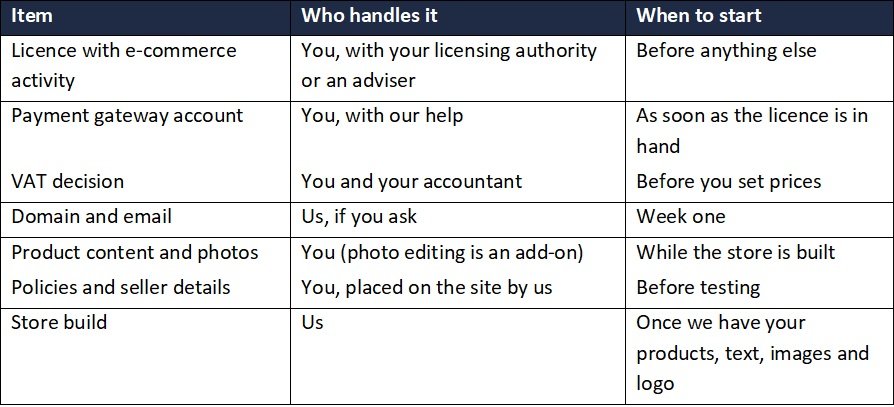
A sensible order of work looks like this. Get the licence sorted. Apply for the gateway account as soon as it arrives. While the application is being reviewed, we build the store and test it with cash on delivery and bank transfer. When the account is approved, the gateway is connected, a test order goes through, and the store opens for real. Nothing waits on anything it doesn't have to.
On our side, delivery counts from the day we have your products, text, images and logo: about three weeks for a Basic store, four for Standard and six for Premium. The sooner your licence and gateway account are in hand, the sooner the store can go live.
Sources: UAE government portal: e-commerce | Federal Tax Authority: VAT registration
Planning a store?
Book a free call and we will give you a rough estimate and an honest view on what fits your business. We reply within one working day.
0 Comments